- Case Studies
How Better Mental Health Care Transitions Can Reduce Readmissions and Costs
Table of Contents
- Introduction
- Elevated Readmission Rates for Mental Health Patients
- Strained Resources and Gaps in Continuous Treatment
- The Solution
- Strengthening Mental Health Care Transitions
- Optimizing the EHR for Documentation and Analytics
- Engaging Patients and Building Trust
- Proactive Patient Engagement
- Efficient Care Coordination
- The Results
- Conclusion
Introduction
Elevated Readmission Rates for Mental Health Patients
Local hospitals continue to serve a large number of individuals seeking treatment for mental health conditions.
In 2021:
- Inpatient admissions for mood disorders reached approximately 847,000.
- Inpatient admissions for schizophrenia reached approximately 383,000.
By 2022, an estimated 37% of individuals with disabilities receiving Medicare were living with serious mental disorders.
Both mood disorders and schizophrenia are associated with elevated readmission rates, increasing pressure on behavioral health facilities and community-based services.
Several factors can contribute to repeated hospitalizations, including:
- Medication management challenges
- Limited outpatient follow-up
- Co-occurring substance use disorders
- Limited access to community-based services
- Gaps in communication between inpatient and outpatient providers
The Mental and Behavioral Health Center operates an integrated delivery system providing inpatient and outpatient mental health services across communities in Georgia and Florida. Recognizing the increased risk of readmission among patients with serious mental health conditions, the center focused on improving discharge planning, strengthening care coordination, and connecting patients with appropriate outpatient resources.
Strained Resources Hinder Continuous Treatment
The Solution
To address these challenges, the Mental and Behavioral Health Center partnered with Medientsky Billing to implement a redesigned care transition process.
The initiative combined:
- Workflow redesign
- Dedicated patient-support roles
- Improved communication between inpatient and outpatient teams
- Enhanced EHR documentation
- Data and analytics
- AI and automation solutions
- Structured discharge and follow-up processes
The center used its analytics capabilities to monitor both care-process metrics and patient outcomes, allowing the team to evaluate the effectiveness of the redesigned approach.
Strengthening Mental Health Care Transitions
The center secured a grant to launch an enhanced care transition project in partnership with Medientsky Billing. The initiative served patients across seven states and involved five outpatient mental health agencies.
The participating organizations collectively provided care to individuals experiencing:
- Severe and persistent mental illnesses
- Co-occurring substance use disorders
- Chronic health conditions
- Socioeconomic challenges
The primary goal was to improve access to community-based support for adult mental health inpatients who were at high risk of readmission.
The project established a collaborative discharge and transition process with an initial goal of reducing readmissions by at least 10%.
The project team focused on:
- Developing mental health interventions that support successful recovery in outpatient settings.
- Increasing access to community mental health resources before discharge.
- Creating a patient-centered recovery model that encourages early patient and family involvement.
- Strengthening patient advocacy and improving the overall patient experience.
- Improving communication between inpatient and outpatient providers to support seamless transitions.
Readmission rates were established as the primary outcome measure, while process metrics were used to monitor recovery planning, outreach, referrals, and follow-up.
Optimizing the EHR for Documentation and Analytics
The Mental and Behavioral Health Center revised its Electronic Health Record (EHR) workflows to improve documentation of:
- Community care coordination
- Transition meetings
- Follow-up appointments
- Discharge record transmission
- Patient and family goal-setting meetings
The center then used its analytics platform, incorporating AI and automation capabilities, to aggregate information from the EHR. This allowed the team to monitor care processes and evaluate outcome measures throughout the transition program.
Engaging Patients and Building Trust
Two key roles were introduced to support patients during the transition from inpatient to outpatient care:
Mental Health Navigator
The mental health navigator worked closely with patients and the care team to:
- Establish outpatient services
- Strengthen discharge planning
- Support patient-centered recovery
- Coordinate follow-up
- Maintain communication with patients and outpatient providers
Peer Support Specialist
The peer support specialist provided an additional layer of patient advocacy and engagement. The role was filled by an individual with lived experience of mental health recovery who had successfully navigated recovery for at least one year and obtained peer support specialist certification. The peer support specialist helped patients participate in care planning, engage with recovery groups, and maintain connections with outpatient services after discharge.
Proactive Patient Engagement
The introduction of these roles supported a comprehensive redesign of the inpatient workflow. Upon admission, the social worker conducted a diagnostic assessment. The mental health navigator then evaluated adult patients for eligibility for the pilot program.
Eligibility criteria included:
- Residing within the metropolitan area
- Having a diagnosed condition associated with a high risk of readmission
- Previous hospitalization or emergency department visits related to mental health
- Lack of available outpatient services
Eligible patients were invited to participate by the mental health navigator. When a patient declined participation, the peer support specialist engaged with the patient to encourage involvement in the program. Participating patients signed a release-of-information form that remained valid for five years, allowing continued information exchange between the center and participating outpatient agencies. This communication helped inpatient and community-based mental health teams remain connected after discharge.
Efficient Care Coordination
The mental health navigator assessed each patient’s needs and submitted referrals to a community hub through a service request. The community coordinator reviewed the request and distributed it to the five participating outpatient mental health agencies. The agencies assessed the patient’s needs and responded within approximately 4–6 hours, when possible, with the services and resources they could provide. The mental health navigator then reviewed the available options with the patient and, together with the community coordinator, identified the agency best suited to the patient’s needs.
Before discharge, the team focused on three key areas:
- Establishing outpatient care early
The selected agency was contacted to begin an on-site assessment and develop an outpatient care plan while the patient was still hospitalized. Beginning this process before discharge helped reduce delays and allowed patients to establish relationships with their outpatient care teams earlier. For patients with complex needs, multiple on-site visits could take place before discharge.
- Supporting medication adherence
Post-discharge prescriptions were filled at the hospital whenever possible to improve medication access after discharge. Pharmacy educators also provided group education covering medication importance, potential side effects, and patient questions.
- Creating a patient-centered recovery plan
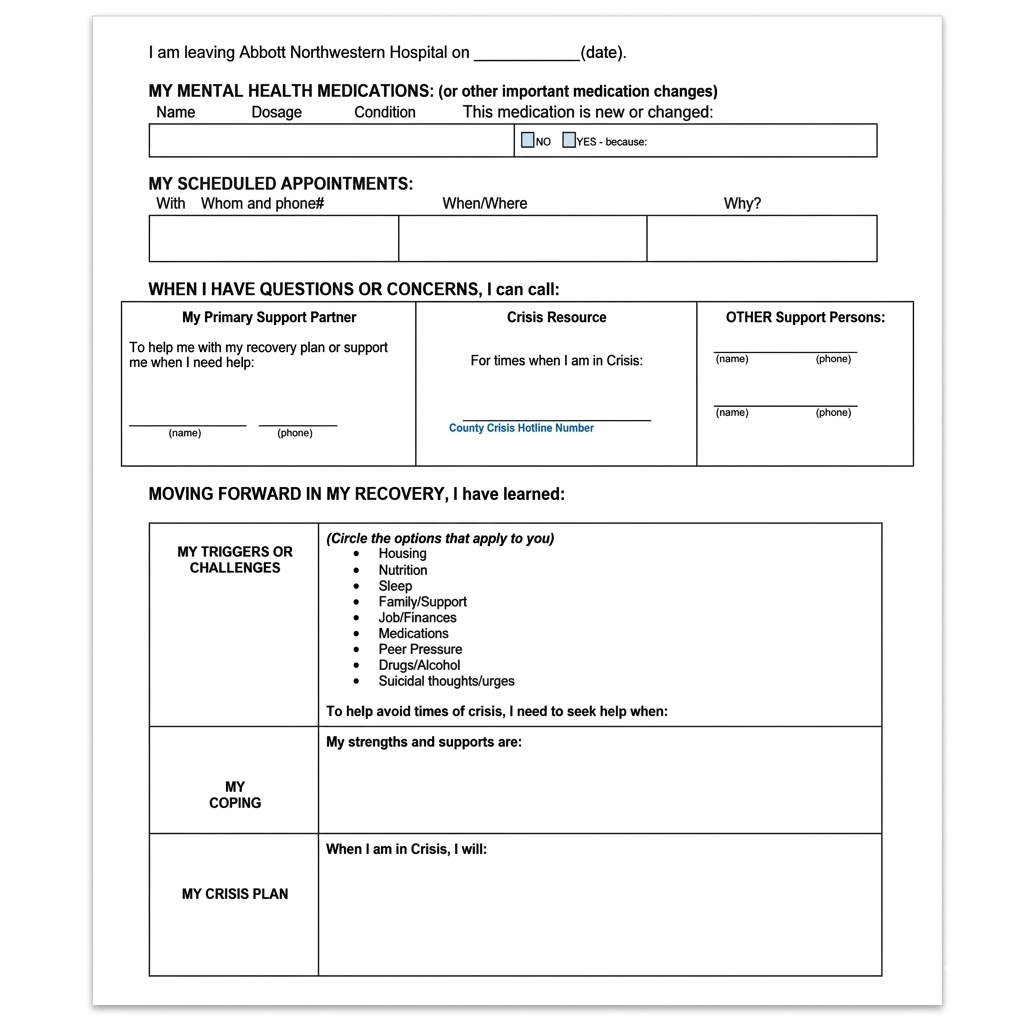
Patients participated in transition meetings, discharge planning, goal setting, and recovery planning. The recovery plan was developed early in the admission process and communicated in patient-centered, easy-to-understand language.
Sample Patient-Centered Recovery Plan
Following discharge, inpatient records and information related to post-discharge needs were transmitted to the next level of care within 24 hours. The outpatient agency contacted the patient within 48 hours of discharge and, when possible, on the day of discharge itself. The mental health navigator and peer support specialist continued supporting patients after discharge. Between 30 and 45 days after discharge, the team conducted a follow-up call with the patient and agency contact to review progress and identify opportunities to strengthen outpatient care.
Supporting Patients When Challenges Arise
The collaborative model also allowed outpatient agencies to quickly involve the mental health navigator and inpatient mental health team when patients encountered problems. In one case, a patient in outpatient care had their medications stolen during a robbery. Because the prescription had been filled within the previous 30 days, the patient’s insurance initially denied coverage for a replacement. The outpatient agency contacted the mental health navigator, who coordinated with the inpatient prescribers and pharmacy team. After working with the insurance company, the team secured coverage for the replacement medication, helping the patient maintain treatment and avoid a potential readmission. In another case, a patient was discharged to a chemical dependency treatment program but was subsequently removed from the program. This created a risk of probation violation and potential incarceration. The mental health navigator helped the patient identify a crisis residence, allowing her to maintain compliance with her probation requirements and avoid incarceration.
Another example involved a 22-year-old homeless man who had experienced multiple admissions related to chemical dependency and a suicide attempt.
He worked with the peer support specialist and was discharged to a faith-based treatment facility for a one-year outpatient treatment program based on his preferences. The peer support specialist maintained regular contact and provided ongoing encouragement throughout his recovery. The patient later began pursuing training to become a peer support specialist himself, with the goal of supporting others facing similar challenges.
Sample Patient-Centered Recovery Plan
The Results
27% Relative Reduction in Potentially Preventable Readmissions
The program achieved a 27% relative reduction in potentially preventable readmission rates. Patients participating in the enhanced care transition program also experienced significantly lower readmission rates compared with the control group. For context, national 30-day readmission rates are approximately:
- 15% for patients with mood disorders
- 22.4% for patients with schizophrenia
The enhanced care transition program achieved a 4.6% 30-day readmission rate.
97% Improvement in Timely Record Transmission
The program achieved a 97% relative improvement in the timely transmission of patient records within 24 hours after discharge. Other care-transition metrics also improved:
- 95% of patients received a structured recovery plan.
- 88% of patients received an on-site agency visit before discharge.
- 94% of patients were scheduled for a follow-up appointment before discharge.
- 100% of patients received a closed-loop call within 45 days after discharge.
- 92% of patients successfully attended their follow-up appointments.
Two patients were unable to attend their follow-up appointments because they were incarcerated. In another case, a patient requested a different psychiatrist and had the appointment rescheduled.
Conclusion
The Mental and Behavioral Health Center’s enhanced care transition program demonstrates how coordinated discharge planning, patient engagement, community partnerships, and structured follow-up can help improve continuity of mental health care. By introducing dedicated navigator and peer-support roles, improving communication between inpatient and outpatient teams, and using data to monitor care processes, the program achieved a 27% relative reduction in potentially preventable readmissions and a 4.6% 30-day readmission rate. The program also achieved improvements in recovery planning, record transmission, pre-discharge coordination, follow-up scheduling, and patient engagement.
For behavioral health organizations facing similar challenges, the results highlight the importance of connecting patients with appropriate community resources before discharge and maintaining that connection after they leave the hospital.
Share it on
Search Latest Case Studies
Highlights
- 60 or even 90 Days referral process
- 30-day Readmission rate for patients
- 4-6 hours, Patient's requirements responds
Client Specs
- Location: Washington
- Specialty: Behavioral Health
- EHR: Incredible
- Average collections: 300K per month
Work with medical billers who understand your EHR's billing process backwards and forwards
Get paid Three times faster with our 24/7 medical billing services.
Avail Free RCM Audit Worth $2,000! Check out 19 different KPI reports that stops your cash flow.