
How Medientsky Billing Increased Revenue for a Northern California OB/GYN Center

Learn how Medientsky Billing helped a busy Northern California ob-gyn practice boost revenue by 50% in 3 months with advanced billing solutions and EFT enrollments.

Table of Contents

Introduction

Every OB/GYN practice has different revenue cycle challenges. Some struggle with claim denials, while others face coding issues, inefficient billing workflows, delayed payments, or difficulties managing patient accounts receivable. A busy OB/GYN practice in Northern California was facing several of these challenges at the same time. The practice was using eClinicalWorks (eCW), while its existing billing company was transmitting claims through Office Ally. The practice wanted to improve its payment process through Electronic Funds Transfer (EFT) and Electronic Remittance Advice (ERA), while also working with a billing team that understood the specific requirements of OB/GYN billing. Medientsky Billing conducted a detailed review of the practice’s billing workflow, coding, payment information, and revenue cycle processes. The review uncovered several areas where revenue was being delayed or left uncollected. By addressing coding issues, timely filing problems, billing workflows, payer enrollment, patient collections, and OB/GYN-specific billing processes, Medientsky Billing helped the practice achieve a 50% increase in monthly revenue within a few months and reduce expenditures by 3%.

The Challenge

The OB/GYN group wanted to improve its operating margin, streamline its processes, and reduce its cost base. The practice had already attempted several initiatives, including cost-cutting programs, lean management, revenue cycle modernization, and efforts to meet cost targets. However, these changes were short-lived and did not create the desired improvement.

Difficulty Retaining Billing Expertise

Hiring and retaining experienced billing professionals was another challenge. Like many medical groups, the practice relied on an outside medical billing agency to supplement its internal resources. However, the billing company was not proficient with the practice’s EHR. Its limited use of eClinicalWorks created operational and revenue cycle problems. Persistent claim delays and low reimbursement added to the pressure on the medical group. At the insistence of the existing billing company, the practice purchased Office Ally to support claims transmission. This created another layer of complexity. The billing company manually downloaded information from eCW, transferred the data into Office Ally, and then transmitted the claims. This created duplicated effort, fragmented billing information, and routine delays.

Problems With the Existing Billing Arrangement

The practice also discovered that its billing company was not adhering to many of the terms outlined in its Service Level Agreement (SLA). The group had to manage pre-authorization tasks internally and also hire a full-time employee to handle checks and EOBs. The practice was therefore dealing with both operational inefficiencies and additional administrative costs while still experiencing inconsistent revenue performance.

Discovery: Auditing the Revenue Cycle

Before recommending changes, Medientsky Billing conducted an audit of the practice’s existing workflow, billing cycle, and payment information. The practice was also concerned about declining patient satisfaction and patient inflow. Some patients had reported dissatisfaction with their billing experiences and were switching to other providers. The audit was designed to identify the underlying deficiencies affecting both financial performance and the patient billing experience. The review focused on the practice’s existing processes and helped identify several opportunities for improvement.

The Solution

Medientsky Billing implemented a multi-part approach that addressed coding, payer requirements, billing workflows, payment processing, patient collections, and OB/GYN-specific revenue opportunities.

Medical coding audit

One of the first areas addressed was coding quality. Medientsky Billing proposed a business intelligence system to identify deficiencies in coding and support more consistent results. The initial review identified claims that had been denied because a critical modifier was missing. The source case study identifies Modifier QW as the missing modifier on many claims. The modifier was added to the affected claims, which were then resubmitted. The audit also identified incorrect coding of bundled payments. Procedures that should have been treated as part of a sequential or bundled service were being unbundled and coded separately. Medientsky Billing addressed these coding issues as part of its broader revenue cycle review.

Improving OB/GYN Billing Practices

The audit also identified an issue with how claims were being submitted during the pregnancy and delivery billing process. According to the case study, the previous billing company was billing each patient visit immediately rather than waiting for the global payment associated with delivery. The example provided in the original case study was:

  • $30 paid for a visit
  • $1,500 paid after a successful delivery
  • 10 visits plus 1 final admission

The case study uses this example to illustrate how the timing and structure of OB/GYN billing can affect total reimbursement. Medientsky Billing applied its experience with OB/GYN billing to help the practice manage these claims more appropriately.

Improving OB/GYN Billing Practices

Timely filing was another significant issue. A claim can be denied when it is submitted after the payer’s allowed filing period. The practice manager was reportedly unaware of several timely filing limits and therefore did not recognize the potential impact of timely filing denials. As a result, the filing window had already closed on several high-dollar claims. Medientsky Billing reviewed payer requirements and maintained a chart to track timely filing deadlines. The source page provides the following examples:

Payer Timely Filing Deadline

Medicare

365 days from date of service

Blue Cross Blue Shield

365 days from date of service

Cigna

90 days from date of service

Medicaid

95 days from date of service

UnitedHealthcare

90 days from date of service

SecureHorizons

90 days from date of service

Health Net

120 days from date of service

These deadlines were used to help categorize and prioritize claims according to their filing windows. Medientsky Billing’s workflow management and revenue cycle reporting software was used to categorize patient visits based on payer timely filing limits. The case study states that analyzing the timely filing requirements and payment mechanisms of insurers with which the providers were credentialed resulted in a 10% revenue increase. The process also helped the practice reduce the risk of claims missing payer filing deadlines

Modernizing the billing cycle

Medientsky Billing worked to consolidate and standardize the practice’s revenue cycle. The modernization effort focused on:

  • Automating key processes
  • Eliminating manual EOB-related work
  • Standardizing denial management
  • Reducing the need for multiple software systems
  • Improving billing workflow efficiency

These changes were designed to address the practice’s immediate revenue challenges while creating a more standardized billing process. Following the changes, the practice saw improvements in revenue and workflow efficiency. The case study reports that monthly revenue increased by 50% within a few months.

ERAs and EFT enrollments

Payment processing was another area where the practice was carrying unnecessary administrative work. The practice had a dedicated resource responsible for collecting and depositing insurance checks. This employee was paid $3,000 and was also required to scan and fax payment information to the billing company for posting. Because the practice and billing company were using different systems, payment information was not centralized. The previous billing company’s handling of ERA and EFT enrollment was also inefficient, increasing the administrative burden on the practice. Medientsky Billing’s OB/GYN billing team completed the ERA and EFT enrollment process and worked to improve payment turnaround time. The implementation also helped organize denial information so that recurring denial issues could be identified and addressed. Following the implementation of ERA and EFT, top denial codes became easier to identify. The denial prevention team then worked on soft denials and denial overturns.

Improving patient experiences

The practice’s financial challenges were also affecting its patient experience. Patients reported receiving confusing bills and receiving vague or inconsistent answers when they contacted the billing department. The lack of clarity around medical bills made some patients uncomfortable with the practice, while others switched to different providers. Medientsky Billing implemented a pilot program focused on improving patient communication and resolving billing concerns. The patient department contacted patients to address questions and complaints related to their bills. The team also identified $37,000 in old patient AR that had been left uncollected.

Patient Billing Improvements

The practice introduced an e-statement pathway that provided patients with a clearer view of their financial responsibilities. The approach included:

  • Sending patient statements electronically
  • Providing financial counseling
  • Giving staff real-time visibility into patient payments
  • Sending estimated charges to patients
  • Educating patients about online payment options
  • Training frontline staff to collect more at the time of service
  • Implementing appointment scheduling tools
  • Implementing insurance eligibility verification tools

These changes were intended to make the billing process easier to understand while helping staff respond to patient questions more efficiently.

Recovering Antepartum Care Revenue

The revenue audit identified another opportunity within the practice’s OB/GYN billing process. Despite being a busy OB/GYN center, the practice’s collections were lower than expected. A closer review revealed that reimbursement for antepartum care was not consistently being collected. The previous billing process had failed to follow up with some patients and collect appropriate reimbursement for antepartum care. Medientsky Billing identified this as an important revenue opportunity based on its experience supporting OB/GYN practices. The patient billing department contacted patients who had moved to other states or practices and worked to recover money associated with previously unbilled antepartum care.

Recovering Previously Unbilled NST Services

The audit also identified NST services that had previously gone unbilled. These services were reviewed and worked on as another opportunity to recover revenue for the OB/GYN medical group. The case study emphasizes that understanding the specific billing requirements and revenue opportunities within OB/GYN can help practices identify services that may otherwise be overlooked.

Improving Global Billing

Medientsky Billing also guided the practice on global billing for obstetrical care. The case study describes the obstetrical period as beginning with the initial visit in which pregnancy is confirmed and continuing through the postpartum period.

The source specifies:

  • 56 days after vaginal delivery
  • 90 days after C-section

The client agreed to close antepartum visits upfront and approved the use of global billing. The practice was also educated on the importance of signing charts for outpatient visits and inpatient services.

AR and Denial Management

Standardizing accounts receivable workflows was another important part of the engagement. Medientsky Billing used its AR management platform to organize the practice’s AR processes and improve revenue capture. The denial management software was used to identify and resolve critical billing issues, accelerate denial recovery, and address controllable write-offs. Denials were categorized based on:

  • Insurer
  • Age
  • Type

This categorization helped the team identify denial patterns and variances that could then be investigated and addressed. The overall objective was to reduce both patient and insurer AR while improving revenue inflow.

Results
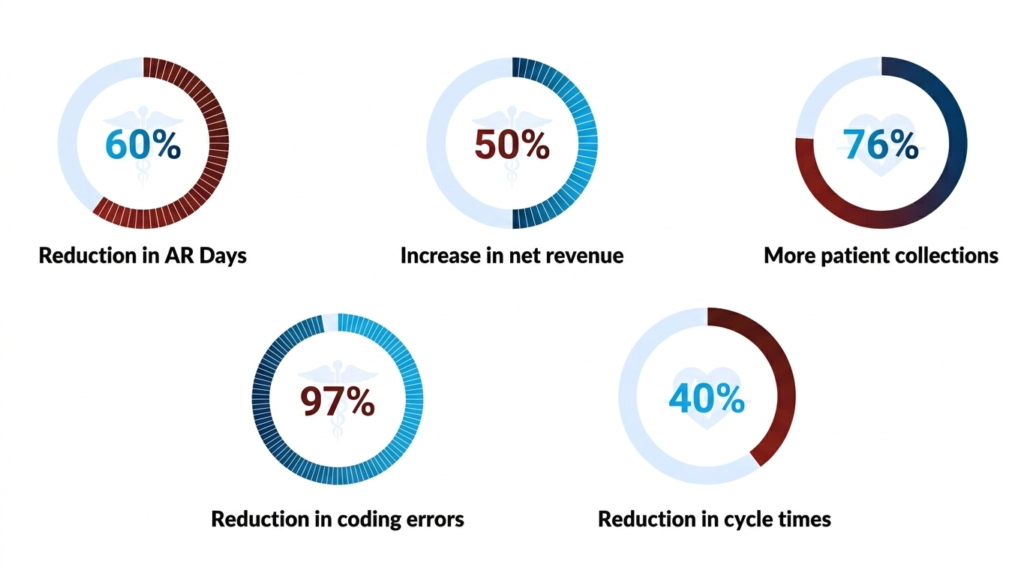
The changes implemented across the practice’s revenue cycle produced measurable improvements.
The combination of coding review, payer analysis, billing-cycle modernization, ERA and EFT enrollment, patient billing improvements, OB/GYN-specific billing knowledge, and AR and denial management provided the practice with a more structured revenue cycle.

Conclusion

This Northern California OB/GYN case study demonstrates how revenue problems can originate from multiple areas of a medical practice’s billing operation. The practice was dealing with fragmented systems, inefficient claims workflows, coding issues, timely filing problems, payment processing challenges, patient billing complaints, and missed revenue opportunities. Medientsky Billing addressed these issues through a detailed revenue cycle audit followed by targeted improvements. The work included reviewing medical coding, correcting missing modifiers, addressing billing practices, monitoring payer timely filing limits, modernizing the billing cycle, completing ERA and EFT enrollment, improving patient billing communication, recovering old patient AR, addressing antepartum and NST billing, and standardizing AR and denial management. According to the case study, the practice achieved a 50% increase in overall net revenue, a 76% increase in patient collections, and a 97% reduction in coding errors as listed in the Highlights section. The case demonstrates the importance of having a billing partner that understands both the technology used by a practice and the specialty-specific requirements of OB/GYN revenue cycle management.

Share it on

Search Latest Case Studies

Highlights

Client Specs

Work with medical billers who understand your EHR's billing process backwards and forwards

Get paid Three times faster with our 24/7 medical billing services.

Avail Free RCM Audit Worth $2,000! Check out 19 different KPI reports that stops your cash flow.

Scroll to Top

Get a Quote

Get a Quote

Fill the following form to join the event

Established Practice

Startup Practice