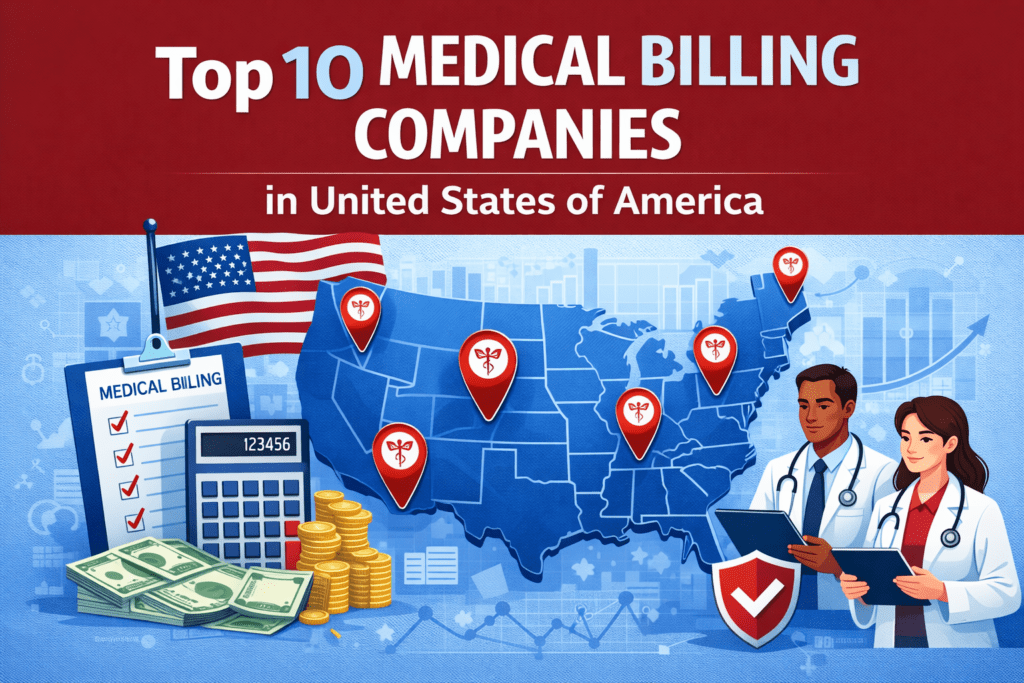
Top 10 Medical Billing Companies in USA
Table of Contents Introduction 10 Medical Companies Conclusion Finding the right medical billing company can transform your practice’s revenue cycle, reduce administrative burden, and improve cash flow. But with so many options, how do you choose? We’ve analyzed the market to bring you a list of the top 10 medical billing companies in the USA for 2024. This list considers factors like technology, compliance, specialty expertise, and client service. 1. R1 RCMA industry giant, R1 offers end-to-end revenue cycle management for large hospitals and health systems. They are known for their powerful technology platform and scalable solutions. 2. AdvantEdge Healthcare SolutionsA leader for both hospitals and physician practices, AdvantEdge provides full-service RCM with strong specialty-specific expertise, particularly in anesthesia, radiology, and pathology. 3. GeBBS Healthcare SolutionsRenowned for its innovation and global delivery model, GeBBS excels in high-volume coding and billing services, offering significant efficiency gains. 4. CureMDA top choice for small to mid-sized practices, CureMD combines its award-winning EHR software with seamless billing services for an integrated workflow solution. 5. WayStarFocused on simplifying healthcare payments, WayStar’s platform is praised for its transparency, robust claims management, and patient payment tools. 6. eClinicalWorksIdeal for practices using their EHR, eClinicalWorks offers tightly integrated billing services that leverage their all-in-one practice management ecosystem. 7. TriZetto Provider Solutions (by Change Healthcare)A powerhouse offering a comprehensive suite of tools for claims, denial management, and eligibility verification, often suited for larger groups. 8. DrChronoPopular with modern, tech-forward practices, DrChrono provides a seamless blend of its iPad-friendly EHR, practice management, and in-house billing services. 9. The SSI GroupSpecializing in the complex needs of hospitals, health systems, and large clinics, SSI is known for its deep regulatory knowledge and claims scrubbing accuracy. 10. MGM Medical Billing ServicesA standout for specialty practices, MGM offers a personalized, high-touch approach with expertise in fields like behavioral health, physical therapy, and dermatology. Choosing the Right Partner:Remember, the “best” company depends on your practice’s size, specialty, budget, and needs. Look for a partner with expertise in your field, transparent pricing, and a technology platform that integrates with your existing systems. Always ask for references and ensure they are fully HIPAA compliant. Ready to streamline your revenue cycle? Contact us to discuss how a professional billing service can be tailored to your practice’s unique goals.