
- Case Studies
Learn how an integrated health system in Dallas zeroed down on legacy AR
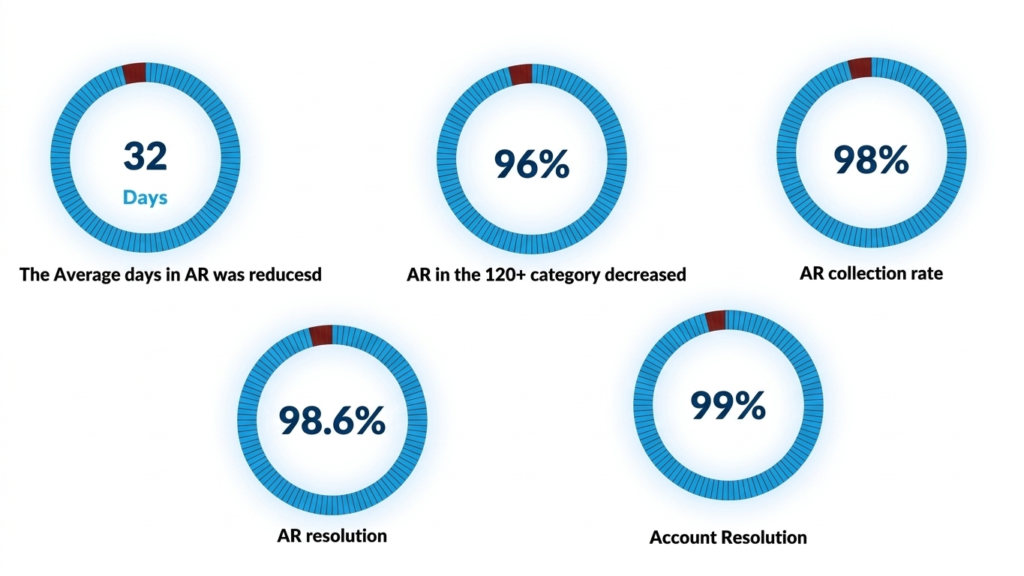
Discover our multi-pronged AR recovery success: 96% reduction in 120+ days AR, 98% collection rate, and average AR days reduced to 32. Download the case study.
Table of Contents
Introduction
An integrated healthcare system based in the Dallas, Texas area approached Medientsky Billing for support in resolving significant outstanding accounts receivable and coding backlogs.
The healthcare system operated multiple primary care locations and provided a broad range of specialized services. Its network included spine, orthopedic and pain management clinics, sports medicine and physical therapy centers, bariatric and general surgery institutes, digestive management clinics, a diagnostic imaging center, and a licensed acute-care surgical hospital.
With a large and complex AR portfolio, the organization needed a structured approach to identify collectible receivables, prioritize high-risk accounts, address coding backlogs, and prevent additional balances from moving into uncollectable categories.
About the client
| Metric | Value |
|---|---|
|
Provider PT |
86 |
|
Charge Lag Average |
20 |
|
Charges per Year |
54M |
|
Charges per Month Average |
4.5M |
|
Average Claims transmit per Month |
4000 |
|
Average Claims transmitted < 48 Hours |
70% |
|
Outstanding AR |
16M |
The Challenge
A Large Legacy AR Portfolio With Ongoing Coding Backlogs
The healthcare system was carrying approximately $16 million in outstanding AR, with $10 million falling into the 120+ day category.
A significant portion of the older receivables was considered difficult or potentially uncollectable. At the same time, the organization was dealing with an increasing coding backlog, creating additional pressure on the revenue cycle team.
The challenge was not simply to recover old AR. The organization also needed to manage its ongoing revenue cycle operations while preventing current receivables from aging further.
Glen Matheson, the healthcare system’s revenue cycle director, described the situation as a difficult balance between clearing existing backlogs and managing current AR issues.
“Every time we try to reduce AR backlogs we hit a blank wall. It is difficult to clear backlogs and handle current AR issues as well. We are desperately looking for AR resolution support to liquidate all that revenue stuck in AR buckets.”
The management team recognized that continued delays could have a long-term impact on cash flow and revenue cycle performance.
Choosing an AR Recovery Partner
Glen Matheson sought proposals from several third-party organizations before selecting Medientsky Billing.
According to the revenue cycle director, Medientsky’s experience handling similar AR projects and its operational approach were important factors in the decision.
Another key consideration was AR Analyzer, Medientsky Billing’s proprietary AR management software.
The organization needed more than a conventional follow-up process. Its AR portfolio required a way to identify the most important receivables, organize work according to risk, and help the revenue cycle team focus its efforts where recovery opportunities were strongest.
The Solution
Medientsky Billing developed a multi-step AR recovery strategy focused on bringing legacy receivables under control while simultaneously addressing the coding backlog.
The approach included:
- AR wind-down services for payer and patient AR
- Lost Revenue Recovery Audit (LRRA)
- Identification of collectible AR
- Prioritization of high-risk receivables
- AR follow-up and resolution
- Coding backlog support
- Preservation of AR asset value
- Ongoing monitoring of current receivables
1. Lost Revenue Recovery Audit
The engagement began with an extensive Lost Revenue Recovery Audit (LRRA).
The audit was designed to identify deficiencies across the existing revenue cycle and determine where opportunities existed to recover outstanding revenue.
Medientsky Billing used the findings to develop recommendations covering both coding and AR management.
The objective was twofold:
- Establish a practical recovery path for older AR.
- Help bring pending coding work and current claims closer to resolution.
This created a foundation for addressing the existing backlog without losing sight of ongoing revenue cycle activity.
2. Identifying Collectible AR
The first operational step was to determine which outstanding accounts remained collectible.
Medientsky Billing evaluated receivables using multiple parameters, including insurance filing limits and appeal limits, and compared those requirements against the age and status of outstanding AR.
This helped separate receivables that still had a viable recovery opportunity from balances that had moved into higher-risk or uncollectable categories.
The goal was not simply to work the oldest accounts first. The AR needed to be organized according to recovery potential and urgency.
3. Prioritizing the Work Queue
After identifying collectible accounts, Medientsky Billing organized the work according to priority.
Immediate-priority claims were addressed first to support faster recovery and reduce the risk of otherwise collectible claims moving into uncollectable buckets.
This approach allowed the AR team to concentrate its efforts on receivables where timely intervention could make the greatest difference.
4. Reviewing Older and Difficult AR
The next stage focused on older AR that initially appeared difficult to collect.
Medientsky Billing reviewed these balances and looked for viable points of contact within insurance organizations to determine whether additional recovery opportunities existed.
This included reviewing bulk claims and overlooked pockets of revenue that may not have received sufficient attention during previous AR follow-up efforts.
Rather than treating every aged account in the same way, the recovery process focused on understanding the characteristics and risk associated with each segment.
AR Analyzer and Risk-Based Work Allocation
A central component of the solution was AR Analyzer, Medientsky Billing’s proprietary AR management software.
According to the case study, AR Analyzer reduces the time and cost involved in AR management by automatically isolating high-risk receivables.
The system categorizes AR according to financial risk, helping streamline the follow-up process.
This risk-based approach allowed Medientsky’s AR resolution experts to focus on the segments requiring the most attention.
AR Analyzer’s prescriptive work-listing engine also allocated work to receivables management teams based on their experience handling similar AR issues.
Instead of relying on a generalized work queue, the team could focus on specific risk segments and the types of AR issues they were equipped to resolve.
Identifying Overlooked Revenue
A detailed review of the healthcare system’s AR information helped Medientsky Billing identify several overlooked pockets of revenue.
Critical AR issues were surfaced through the system and assigned for resolution.
This was particularly important for a healthcare organization with a large and diverse AR portfolio. With millions of dollars outstanding, even smaller overlooked segments could represent meaningful recovery opportunities.
The combination of AR analysis, risk categorization, prioritized work allocation, and dedicated follow-up created a more structured approach to legacy AR recovery.
Bringing Legacy AR Under Control
The broader objective of the engagement was to bring the healthcare system’s outstanding AR closer to current status while strengthening the processes supporting future revenue.
Medientsky Billing’s AR resolution team worked on key risk segments while providing ongoing AR follow-up.
The approach addressed both sides of the problem:
Legacy AR:
Identify collectible balances, prioritize recovery opportunities, investigate difficult accounts, and pursue overlooked revenue.
Ongoing AR:
Support current receivables and reduce the likelihood that collectible balances would continue aging without appropriate follow-up.
The case study states that Medientsky Billing’s 24/7 AR follow-up services supported the healthcare organization in recovering revenue associated with inefficient and poorly monitored AR processes.
Results
Conclusion
Managing a large legacy AR portfolio requires more than simply increasing the number of follow-up calls or assigning additional staff to old accounts.
For this integrated healthcare system, the challenge involved millions of dollars in outstanding receivables, a significant 120+ day AR balance, and a growing coding backlog.
Medientsky Billing addressed the challenge through a structured AR recovery strategy built around an LRRA audit, collectible AR identification, risk-based prioritization, dedicated AR resolution, coding backlog support, and AR Analyzer.
The reported results included a 96% reduction in 120+ day AR, a reduction in average AR days to 32, and a 98% AR collection rate.
The case demonstrates how a systematic approach to legacy AR can help healthcare organizations identify overlooked revenue, prioritize recovery opportunities, and bring greater structure to complex accounts receivable portfolios.
For healthcare organizations facing persistent aged AR and revenue trapped in unresolved balances, a detailed AR assessment can help identify where recovery opportunities exist and where existing processes may be allowing collectible revenue to age unnecessarily.
– Glen Matheson, revenue cycle director
Share it on
Search Latest Case Studies
Highlights
- The average days in AR was reduced to 32 days
- AR in the 120+ category decreased by 96%
- 98% AR collection rate
Client Specs
- Location: Washington
- Specialty: Behavioral Health
- EHR: Incredible
- Average collections: 300K per month
Work with medical billers who understand your EHR's billing process backwards and forwards
Get paid Three times faster with our 24/7 medical billing services.
Avail Free RCM Audit Worth $2,000! Check out 19 different KPI reports that stops your cash flow.